Evaporative Cooling Pad Guide for Poultry & Livestock Farms
An evaporative cooling pad is a honeycomb-structured cellulose medium that lowers incoming air temperature through the natural process of water evaporation. In poultry and livestock houses, it is the most energy-efficient method of reducing heat stress, improving feed conversion, and maintaining egg production during hot seasons. Water trickles down the corrugated pad surface while hot outside air is drawn through it by exhaust fans; the air cools by 5–12 °C depending on humidity. Correctly sized and installed cooling pads keep birds within their thermoneutral zone at a fraction of the operating cost of refrigerated air conditioning. This guide explains how evaporative cooling pads work, their specifications, applications in poultry and livestock farming, advantages, and practical selection criteria.
What Is an Evaporative Cooling Pad?
An evaporative cooling pad, also called a wet curtain or cellulose cooling pad, is a thick, corrugated sheet of specially treated cellulose paper arranged in a cross-fluted honeycomb pattern. Water is distributed across the top of the pad and flows down both the front and back surfaces, saturating the entire medium. When hot, dry outside air is pulled through the wet pad by negative-pressure exhaust fans, water evaporates from the pad surface and absorbs heat from the air. The air leaves the pad cooler and slightly more humid, and is then distributed throughout the animal house.
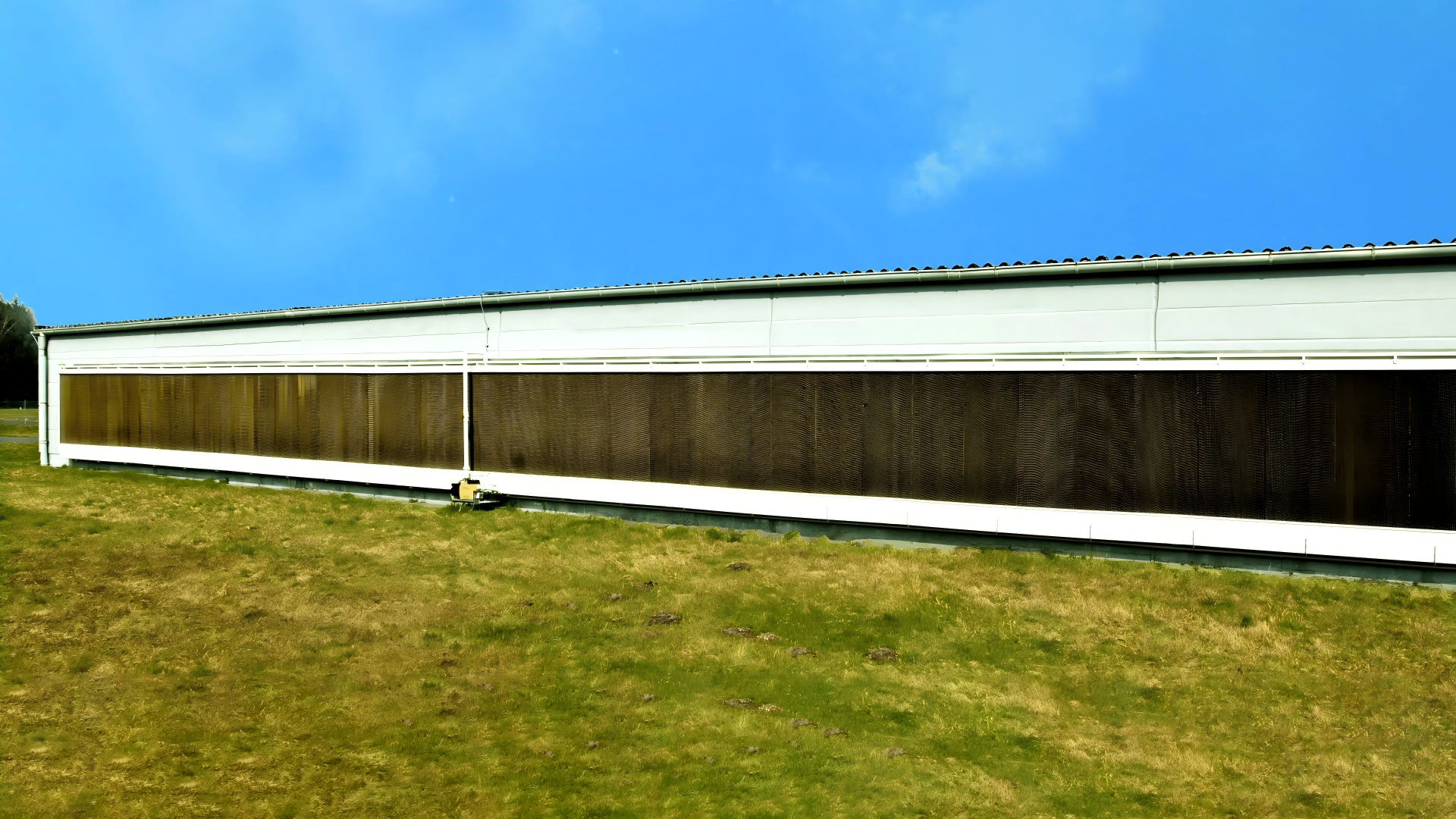
Unlike misting or fogging systems, evaporative cooling pads do not add free water droplets to the house air. This avoids wet litter, respiratory problems, and equipment corrosion. The pads are typically mounted in the side walls or end walls of a tunnel-ventilated building, with exhaust fans at the opposite end drawing air through the entire length of the house.
The Evaporative Cooling Principle
The cooling effect relies on the conversion of sensible heat into latent heat. As unsaturated air passes over the wet pad, water molecules absorb heat energy from the air and become vapour. The dry-bulb temperature of the air drops, while its relative humidity rises. The theoretical maximum cooling is the difference between the dry-bulb and wet-bulb temperatures, known as the wet-bulb depression. Modern cellulose pads achieve 85–92% of this theoretical maximum, giving practical temperature reductions of 5–12 °C in most poultry-farming regions.
Key Components of a Cooling Pad System
- Cellulose pad medium: Cross-fluted honeycomb paper, chemically treated to resist mould, algae, and rot.
- Pad frame: Aluminium alloy, galvanised steel, or stainless steel casing that holds the pad and distributes water.
- Water distribution pipe: Perforated PVC or stainless steel header pipe running along the top of the pad.
- Water collection trough: Bottom tray that collects unevaporated water and returns it to the tank.
- Circulation pump: Low-power pump (typically 0.37–1.1 kW) that lifts water from the tank to the header pipe.
- Water tank and filter: Reservoir with a mesh or sand filter to remove debris and prevent nozzle blockage.
- Exhaust fans: Tunnel-ventilation fans sized to pull air through the pad at the correct face velocity.
- Control system: Thermostat or climate controller that starts the pump and fans when house temperature exceeds the set point.
Typical Specifications of Evaporative Cooling Pads
- Thickness: 100 mm (4″), 150 mm (6″), 200 mm (8″) — thicker pads give higher efficiency and lower pressure drop.
- Flute angle: 45°/45° for standard cooling; 60°/30° for higher efficiency and lower resistance.
- Evaporation efficiency: 85–92% (150 mm pad), up to 95% for 200 mm premium media.
- Face velocity: 1.5–2.5 m/s through the pad (higher velocity increases pressure drop and reduces efficiency).
- Pressure drop: 15–30 Pa at 2.0 m/s for a 150 mm pad; 25–45 Pa for a 200 mm pad.
- Standard dimensions: Height 1500 / 1800 / 2000 mm; width 600 / 900 / 1200 mm; custom sizes available.
- Water flow rate: 4–8 L/min per metre of pad width.
- Material: Cellulose paper with special resin treatment; frame in aluminium, galvanised steel, or 304 stainless steel.
- Service life: 5–8 years with proper water treatment and annual cleaning; 10+ years with stainless steel frame and filtered water.
Applications in Poultry & Livestock Farms
Poultry Houses – Layers, Broilers & Breeders
Evaporative cooling pads are essential in tunnel-ventilated layer, broiler, and breeder houses in hot climates. Birds are highly susceptible to heat stress: when house temperature exceeds 30 °C, feed intake drops, egg production falls, shell quality deteriorates, and mortality rises sharply. Cooling pads lower the incoming air temperature by 5–12 °C, keeping the house within the bird’s thermoneutral zone (18–24 °C for layers, 18–22 °C for broilers). This protects production, improves feed conversion, and reduces mortality during heat waves.
Pig Farms – Gestation, Farrowing & Finishing
Sows and finishing pigs also suffer from heat stress, which reduces feed intake, lowers daily weight gain, and increases stillbirth rates in farrowing houses. Cooling pads provide effective temperature control in gestation barns, farrowing rooms, and finishing sheds. Because pigs are more sensitive to humidity than poultry, pads are usually operated at lower face velocities and combined with adequate ventilation to prevent excessive humidity buildup.
Dairy & Cattle Barns
In dairy operations, heat stress reduces milk yield by 10–25% and lowers fertility. Evaporative cooling pads installed in free-stall barns and holding pens provide a comfortable microclimate for high-producing cows. They are often used in combination with tunnel ventilation and recirculation fans to deliver cooled air directly to the cow lying area.
Greenhouses, Sheep & Rabbit Houses
The same principle applies in greenhouses, sheep sheds, rabbit houses, and equine stables. Cooling pads maintain a stable growing or living environment during summer, protecting plant yields and animal welfare. In greenhouses, they are often paired with shading screens and forced ventilation to achieve precise temperature and humidity control.
Key Advantages of Evaporative Cooling Pads
- Energy-efficient cooling: Consumes only the power of a small pump and the ventilation fans — typically 80–90% less energy than refrigerated air conditioning.
- Significant temperature reduction: Cools incoming air by 5–12 °C, depending on ambient humidity and pad thickness.
- Improved animal performance: Reduces heat stress, protecting feed intake, weight gain, egg production, and milk yield.
- Lower mortality: Prevents heat-related deaths during extreme summer conditions.
- No wet litter or droplets: Unlike misting systems, evaporative pads add only water vapour to the air, keeping bedding dry and reducing respiratory disease.
- Low maintenance: Requires only periodic cleaning, water quality management, and pump inspection.
- Long service life: Quality cellulose pads last 5–8 years; stainless steel frames extend life to 10+ years.
- Scalable and modular: Pads can be added in sections to match any house size or ventilation capacity.
How to Choose the Right Evaporative Cooling Pad
Pad Thickness and Cooling Efficiency
Thicker pads provide higher evaporation efficiency and lower pressure drop, but they occupy more wall space and cost more. As a general rule:
- 100 mm (4″): Efficiency 75–85%. Suitable for low-humidity regions and small houses.
- 150 mm (6″): Efficiency 85–92%. The most common choice for poultry and pig farms — best balance of performance and cost.
- 200 mm (8″): Efficiency 90–95%. Recommended for high-humidity areas or where maximum cooling is required.
Calculating the Required Pad Area
Pad area is determined by the total ventilation capacity of the house and the desired face velocity. The formula is:
Pad Area (m²) = Total Fan Capacity (m³/h) ÷ (Face Velocity (m/s) × 3600)
For poultry houses, a face velocity of 1.8–2.2 m/s is typical. For pig houses, 1.2–1.8 m/s is preferred to avoid excessive humidity. Always add 10–15% extra pad area as a safety margin for hot, humid days when efficiency drops.
Water Quality and Filtration
Water quality is the single most important factor affecting pad life and performance. Hard water causes scale buildup that blocks the corrugations; iron and manganese promote algae and bacterial growth; suspended solids clog the distribution holes. Install a sand filter or mesh filter on the water supply, and use a water softener if hardness exceeds 200 mg/L as CaCO₃. Recirculated water should be dumped and replaced at least weekly, or more often in dusty conditions. Some systems include automatic bleed-off valves to prevent concentration of dissolved solids.
Frame Material and Installation Orientation
- Aluminium frame: Lightweight, corrosion-resistant, and easy to install. Suitable for most farm environments.
- Galvanised steel frame: Stronger and more rigid, but can rust if the zinc coating is damaged. Good for large pads.
- 304 stainless steel frame: Best corrosion resistance for coastal or high-humidity farms; highest cost but longest life.
- Orientation: Pads are mounted vertically on the side wall or end wall. Ensure the pad is level and the water distribution pipe is horizontal. Allow a 300–500 mm air gap between the pad and any wall or obstruction on the outside to ensure uniform airflow.
Control and Automation
Modern cooling pad systems can be integrated with a farm climate controller. The controller monitors house temperature and humidity, and automatically starts the pump and increases fan speed when the temperature rises above the set point. It can also stage multiple cooling pad sections to avoid sudden temperature drops. For maximum efficiency, combine the cooling pad with tunnel ventilation and internal recirculation fans to distribute the cooled air evenly throughout the house.
Need a custom cooling pad system sized for your poultry house, pig barn, or dairy shed? Our technical team provides free pad area calculation, layout drawings, and water treatment advice — request a quote or browse our cooling pad range.
Frequently Asked Questions
What is the ideal thickness for a poultry cooling pad?
For most poultry houses in hot climates, a 150 mm (6-inch) pad offers the best balance of cooling efficiency (85–92%), pressure drop, and cost. In areas with very low humidity, a 100 mm pad may be sufficient. In high-humidity regions or where maximum cooling is critical, choose a 200 mm pad. Thicker pads also tolerate dust and scale buildup better, extending service life between cleanings.
How do I calculate the cooling pad area for my poultry house?
Use the formula: Pad Area (m²) = Total Fan Capacity (m³/h) ÷ (Face Velocity (m/s) × 3600). For poultry, a face velocity of 1.8–2.2 m/s is recommended. For example, if your fans move 40,000 m³/h and you want 2.0 m/s, the pad area = 40,000 ÷ (2.0 × 3600) = 5.56 m². Add 10–15% safety margin, so specify approximately 6.2–6.4 m². Always confirm with your equipment supplier.
How often should cooling pads be replaced?
With proper water treatment and annual cleaning, quality cellulose cooling pads last 5–8 years. Pads in dusty environments or with unfiltered hard water may need replacement after 3–4 years. Signs that replacement is due include visible sagging, crumbling edges, persistent algae growth, or reduced cooling efficiency despite correct water flow. Stainless steel frames can outlast several pad replacements.
Can evaporative cooling pads be used in pig farms?
Yes. Cooling pads are widely used in gestation, farrowing, and finishing pig houses. However, pigs are more sensitive to high humidity than poultry, so the system should be designed with a lower face velocity (1.2–1.8 m/s) and adequate ventilation to prevent the house from becoming excessively humid. In farrowing rooms, cooled air should be directed away from newborn piglets, which require a warm microclimate.
How do I maintain an evaporative cooling pad system?
Routine maintenance includes: checking water flow and distribution holes weekly; cleaning the water filter and tank monthly; inspecting the pad surface for algae, scale, or debris and cleaning with a soft brush and mild disinfectant as needed; checking the pump and float valve for correct operation; and flushing the system and replacing water at least weekly. At the end of the cooling season, drain the system, clean the pads, and cover them to prevent dust accumulation.
What is the difference between 45°/45° and 60°/30° cooling pads?
The flute angle describes the direction of the corrugations relative to the pad surface. 45°/45° pads have symmetric flutes and are the standard choice for most farm applications. 60°/30° pads have a steeper angle that increases the contact area between air and water, improving evaporation efficiency slightly, but they also produce a higher pressure drop. For most poultry and livestock houses, 45°/45° pads provide the best overall performance.
Related resources:
Ready to keep your animals cool this summer? Contact our cooling specialists for a free system design, pad area calculation, and competitive quote.