Complete Guide to Chicken Cage Materials, Specifications and Standard Usage Skills
For both beginner backyard chicken raisers and professional commercial poultry farmers, choosing and using a suitable chicken cage is the core foundation of successful breeding. Many farmers only focus on the price and appearance of chicken cages when purchasing, ignoring material differences, standard specification parameters and scientific usage methods. This will easily cause cage rust and deformation, chicken stress, low egg production rate and even frequent disease problems in the later stage.
Different from conventional market analysis and trend sharing, this blog will focus on practical and professional knowledge, systematically sort out mainstream chicken cage material identification methods, complete specification classification, and standardized installation and daily usage skills, helping global buyers and farmers select matching equipment and standardize breeding operations.
1. Core Material Classification & Identification of Chicken Cages
The service life, anti-rust ability, load-bearing performance and breeding safety of chicken cages are completely determined by raw materials. At present, mainstream chicken cage materials on the market are divided into three categories: hot-dip galvanized, cold-galvanized (electro-galvanized) and plastic-coated materials. Each material has obvious differences in performance, applicable scenarios and service life, which can be clearly distinguished through simple identification methods.
1.1 Hot-Dip Galvanized Material (Commercial Farm Premium Choice)
Hot-dip galvanized chicken cage is the mainstream high-end material for large and medium-sized commercial poultry farms. The whole cage is soaked in high-temperature zinc liquid, with a thick and uniform zinc layer (35μm-200μm). The zinc layer is closely combined with the steel wire, featuring strong anti-corrosion, anti-rust and anti-oxidation ability.
Core advantages: Long service life up to 15-20 years, no rust in humid, coastal and high-temperature chicken houses, strong tensile resistance, not easy to deform after long-term load-bearing. It can adapt to fully automatic breeding equipment matching and long-term intensive breeding.
Applicable scenarios: Large-scale layer farms, broiler farms, automated breeding bases, overseas high-humidity and coastal breeding areas.
1.2 Cold-Galvanized (Electro-Galvanized) Material (Economical Civilian Choice)
Cold galvanizing is an electroplating process. The surface zinc layer is thin (5μm-15μm) and uneven. The production cost is low, so the price of cold-galvanized chicken cages is more competitive.
Core disadvantages: The zinc layer is easy to fall off after friction and moisture erosion. It will rust obviously within 1-2 years in humid environments, resulting in wire breakage and cage deformation. The load-bearing toughness is weak, and it is not suitable for long-term high-density breeding.
Applicable scenarios: Small family backyard breeding, short-term temporary breeding, low-budget small farms.
1.3 Plastic-Coated Steel Material (Household Anti-Scratch Choice)
This kind of chicken cage is based on galvanized steel wire with a layer of PVC plastic coating on the surface. It is smooth and burr-free, which can effectively prevent chicken body scratches and foot injuries.
Core advantages: Anti-corrosion, anti-rust, soft surface, low chicken injury rate, easy to clean dirt and feces.
Applicable scenarios: Small household breeding, young chick breeding, ornamental poultry breeding.
2. Complete Specification Classification of Chicken Cages (By Breeding Stage & Structure)
There is no one-size-fits-all standard specification for chicken cages. The international mainstream classification is based on breeding stage (chick, growing chicken, laying hen, breeder chicken) and structural type (A-type, H-type, flat type). Matching specifications according to chicken age and breeding density is the key to improve survival rate and egg production rate.
2.1 Chick Brooder Cage Specifications
Specially designed for 0-60 day-old young chicks, with low cage body height and dense mesh to prevent chicks from escaping and falling. The standard single cage size is 180cm×50cm×35cm, with 3-4 layers. Each cage can hold 10-15 chicks. The mesh gap is small, which avoids chick foot clamping and body injury, and is equipped with special adjustable feeding and drinking troughs for young chicks.
2.2 Growing Chicken Cage Specifications
Suitable for 61-140 day-old growing pullets. The cage body is properly enlarged, with standard dimensions of 190cm×55cm×40cm. The internal space is spacious enough to meet the growth and activity needs of young chickens, reserve space for later feather development and body shaping, and effectively avoid growth stunting caused by overcrowding.
2.3 Layer Chicken Cage Specifications (A-Type & H-Type)
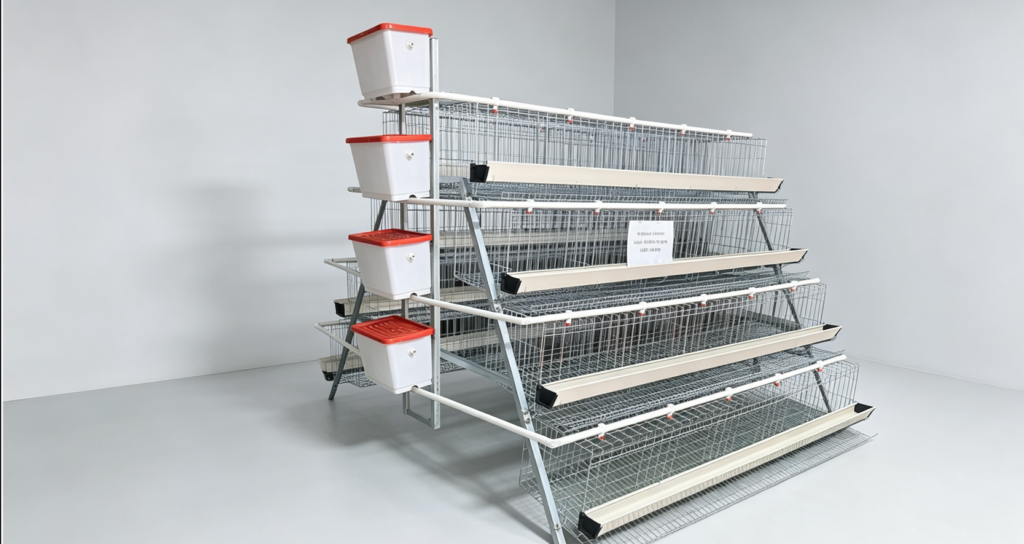
A-type layer cage is the most widely used specification in the world, with staggered layered design, good natural ventilation and light transmission. The standard single-group specification is 195cm×45cm×38cm, 3-4 layers, suitable for medium and small farms and high-temperature and stuffy breeding areas.
H-type stacked layer cage adopts vertical superposition design, with ultra-high space utilization rate. The conventional specification is 200cm×48cm×40cm, 4-6 layers. It supports fully automatic feeding, drinking, manure cleaning and egg collection linkage, and is exclusive for large-scale intensive commercial farms.
2.4 Broiler & Breeder Chicken Cage Specifications
Broiler cages focus on load-bearing and activity space, with standard size of 140cm×42cm×70cm, reasonable spacing to meet the fast fattening growth of broilers. Breeder cages are wider and taller, with a specification of 195cm×60cm×45cm, which is convenient for natural mating and improves breeding hatching rate.
3. Standard Installation & Scientific Usage Methods of Chicken Cages
High-quality chicken cages need standardized installation and scientific usage to maximize service life and breeding efficiency. Many farmers’ improper installation and daily operation lead to premature equipment damage and chicken health problems. The following are universal standard usage steps suitable for all types of chicken cages.
3.1 Pre-Use Installation Standard Steps
First, choose a flat, dry and well-ventilated site to place the chicken cage, avoid long-term damp ground and direct strong wind exposure. Second, fix the cage frame firmly to ensure no shaking or tilting, prevent cage body deformation caused by chicken activity. Third, check all welding points and mesh connections to eliminate burrs and sharp edges, avoid chicken scratch injuries. Finally, install supporting facilities such as feeding troughs, drinking systems and manure trays horizontally to ensure smooth feeding, drinking and manure cleaning.
3.2 Scientific Density Matching Usage
Overcrowding is the main cause of low egg production and disease prevalence. Follow the international standard density: 3-4 square feet of indoor space per adult laying hen, 2 square feet per bantam chicken, and strictly control the number of chickens in a single cage. Do not blindly increase the stocking density for higher output, so as to avoid feather pecking, stress response and cross-infection of diseases.
3.3 Daily Standardized Operation & Maintenance Usage
In daily breeding, keep the cage body dry and clean at all times, clean manure regularly to avoid long-term manure corrosion leading to cage rust. Check the tightness of the cage door lock regularly to prevent predator invasion and chicken escape. For automatic chicken cages, inspect motors, conveyor belts and water supply pipelines regularly to ensure the normal operation of feeding, drinking and manure cleaning systems.
In rainy and humid seasons, strengthen ventilation and dehumidification; in high-temperature summer, open the ventilation windows of the cage body to reduce temperature and prevent heat stress; in cold winter, close the ventilation gap properly to keep warm and avoid frostbite of chickens.
4. Common Usage Mistakes & Avoidance Tips
Many farmers ignore detailed usage specifications, resulting in shortened cage service life and reduced breeding benefits. First mistake: Using cold-galvanized cages in humid coastal areas, which is extremely prone to rust and damage. Second mistake: Excessive stocking density, ignoring chicken activity space standards. Third mistake: Unfixed cage body, long-term shaking leading to wire mesh deformation. Fourth mistake: No regular cleaning, manure accumulation corrodes the cage body and breeds bacteria.
The correct way is to select materials according to the regional environment, match specifications according to breeding quantity, standardize installation and daily maintenance, so as to ensure long-term stable operation of the chicken cage and create a healthy growth environment for the flock.
Final Summary
The selection and use of chicken cages are not simply purchasing equipment, but a systematic breeding matching work. Distinguishing hot-dip galvanized, cold-galvanized and plastic-coated materials, selecting targeted specifications according to breeding stages, and cooperating with standardized installation and scientific daily usage can effectively extend the service life of chicken cages, reduce breeding costs, improve chicken survival rate and egg production efficiency.
Whether you are a beginner backyard breeder or a large commercial farm operator, choosing cost-effective and suitable chicken cage equipment and standardizing usage is the most cost-effective investment for long-term poultry breeding.