Poultry Plucking Machine: Complete Guide for Farms, Slaughterhouses & Processing Plants
A poultry plucking machine, also known as a chicken de-feathering machine or feather removal machine, is a specialised device that rapidly removes feathers from chickens, ducks, geese, quails, and other poultry after slaughter. Using a rotating drum fitted with rubber fingers, the machine creates a high-speed vortex that strips feathers in 30–90 seconds while preserving the skin and meat quality. Modern plucking machines are available in stainless steel construction with capacities ranging from 2 to 1,000 birds per hour, making them essential equipment for family farms, commercial poultry processors, and slaughterhouses. This comprehensive guide covers the construction, working principle, key applications, advantages, and selection criteria for poultry plucking machines, helping you choose the right model for your operation.
What Is a Poultry Plucking Machine?
A poultry plucking machine is a mechanical device designed to remove feathers from poultry carcasses efficiently and hygienically. It replaces manual hand-plucking, which is slow, labour-intensive, and inconsistent. The machine operates by spinning a set of rubber fingers or a rubber-lined drum at high speed, creating friction and centrifugal force that pulls feathers from the skin. Depending on the model, plucking machines can handle one bird per cycle or operate as continuous-flow systems processing hundreds of birds per hour.
Key Components of a Poultry Plucking Machine
A typical plucking machine consists of the following essential components:
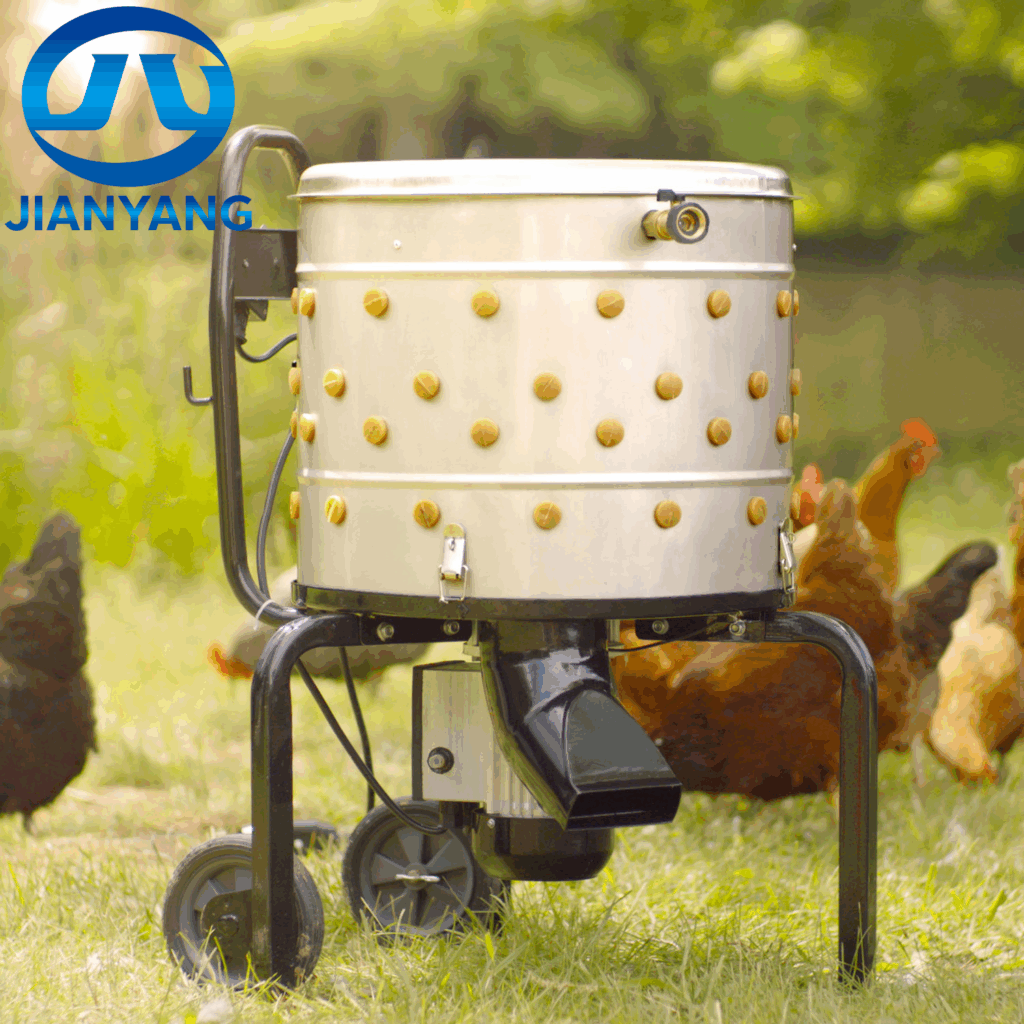
- Rotating drum / plucking bowl: The central cylinder or bowl where the bird is placed. It is lined with dozens of flexible rubber fingers that grip and pull feathers.
- Rubber fingers (plucking fingers): Durable, food-grade rubber projections arranged in rows inside the drum. They come in various hardness grades (soft, medium, hard) and lengths (typically 70–110 mm) to suit different bird sizes.
- Motor and drive system: Electric motor (0.75–4 kW) driving a belt or direct-drive mechanism to spin the drum at 900–1,500 rpm.
- Water spray system: A built-in nozzle or hose connection that sprays water during plucking to lubricate the feathers, wash away debris, and improve skin quality.
- Stainless steel housing: Corrosion-resistant 304 stainless steel body for hygiene and durability in wet environments.
- Control switch / emergency stop: Simple on/off controls with safety features to shut down the machine instantly if needed.
- Discharge chute (optional): Allows the plucked bird to exit the drum without manual removal, improving efficiency.
How Does a Poultry Plucking Machine Work?
The working principle of a plucking machine is based on friction and centrifugal force. After the bird is slaughtered and briefly scalded in hot water (60–65°C for 45–90 seconds), the feathers loosen. The bird is then placed inside the plucking drum.
- Rotation: The drum spins at high speed, causing the rubber fingers to repeatedly strike the bird from all directions.
- Feather removal: The friction and beating action dislodge feathers, which fall through the gaps between the fingers into a collection tray or wash away with water.
- Cycle time: A single bird is typically fully plucked in 30–90 seconds, depending on the bird’s size and the scalding quality.
- Water spray: Continuous water spray during operation helps flush feathers and keeps the skin clean and undamaged.
For higher-capacity models, the machine operates as a continuous flow system: birds enter from one side, pass through the plucking chamber, and exit fully plucked at the other end.
Typical Specifications
- Capacity: 2–5 birds/cycle (small), 50–200 birds/hour (medium), 300–1,000 birds/hour (industrial)
- Motor power: 0.75 kW (small), 1.5–2.2 kW (medium), 3–4 kW (industrial)
- Drum speed: 900–1,500 rpm (adjustable on advanced models)
- Material: 304 stainless steel drum and housing; food-grade rubber fingers
- Voltage: 220 V single-phase or 380 V three-phase
- Water consumption: 5–15 L/min (depending on model)
- Noise level: 65–80 dB
- Weight: 30 kg (small) to 350 kg (industrial)
Applications Across the Poultry Industry
Family Farms & Small Holdings
Small-scale plucking machines with 2–5 bird capacity per cycle are ideal for family farms, backyard poultry keepers, and weekend processors. They typically run on 220 V single-phase power, weigh under 50 kg, and require minimal installation. These machines save hours of manual plucking labour and deliver a cleaner, more consistent finish.
Commercial Poultry Processing
Medium-capacity machines (50–200 birds/hour) are widely used in commercial poultry processing plants, butcher shops, and wet markets. These models often feature stainless steel construction, water spray systems, and rubber finger configurations optimised for chickens, ducks, or geese. They integrate easily into existing slaughter lines and can be paired with scalding tanks and evisceration stations.
Industrial Slaughterhouses
High-throughput plucking machines (300–1,000 birds/hour) are the backbone of industrial poultry slaughterhouses. These continuous-flow systems use multiple plucking stations, adjustable drum speeds, and automated conveyor feeding to handle large volumes with minimal labour. They are built from heavy-duty 304 stainless steel and comply with international food safety standards (HACCP, CE, ISO 9001).
Speciality Birds – Ducks, Geese & Quail
Different bird species require different plucking configurations. Ducks and geese have denser, more water-resistant feathers and require higher scalding temperatures (65–70°C) and machines with softer rubber fingers to avoid skin damage. Quail are small and delicate, requiring gentle plucking drums with reduced speed. Many manufacturers offer interchangeable drums or adjustable finger sets for multi-species processing.
Key Advantages of Poultry Plucking Machines
- Dramatic labour savings: A single machine can replace 5–10 manual pluckers, cutting labour costs by up to 80%.
- Fast processing speed: 30–90 seconds per bird compared to 5–10 minutes for manual plucking.
- Consistent, high-quality results: Rubber fingers remove feathers uniformly without tearing the skin or damaging the meat.
- Improved hygiene: Continuous water spray flushes away feathers and debris, reducing bacterial contamination.
- Stainless steel construction: 304 food-grade stainless steel resists corrosion and is easy to clean and sanitise.
- Low maintenance: Rubber fingers are replaceable and typically last 6–12 months in commercial use; other components require minimal servicing.
- Compact and portable: Small and medium models can be moved easily between processing areas or farms.
- Energy efficient: A 1.5 kW motor consumes less electricity than hiring multiple workers for manual plucking.
How to Choose the Right Poultry Plucking Machine
Determine Your Required Processing Capacity
Match the machine’s capacity to your daily or hourly processing volume. For household use or small farms processing fewer than 20 birds per day, a 2–5 bird per cycle drum machine is sufficient. For commercial operations processing 100–500 birds per day, choose a 50–200 birds/hour model. Industrial slaughterhouses processing thousands of birds daily require continuous-flow systems rated at 300–1,000 birds/hour. Always choose a machine with 20–30% spare capacity to accommodate peak processing days.
Material and Build Quality
- 304 stainless steel: The industry standard for hygiene, corrosion resistance, and durability. Avoid machines with painted or galvanised steel drums, which can chip and contaminate food.
- Rubber finger quality: Look for food-grade, non-toxic rubber fingers with high elasticity. The number of fingers per drum (typically 60–120) affects plucking efficiency. Soft fingers are better for ducks and geese; medium-hard for chickens.
- Motor brand and power: Choose a reputable motor brand with overload protection. A 1.5–2.2 kW motor is suitable for most medium-capacity machines; industrial models require 3–4 kW.
- Bearing and drive system: Sealed bearings and belt-driven systems reduce maintenance and noise compared to chain drives.
Type of Poultry Being Processed
Different birds require different plucking configurations:
- Chickens & Broilers: Medium-hard rubber fingers, drum speed 1,000–1,200 rpm, scalding temperature 60–62°C.
- Ducks & Geese: Soft rubber fingers, slightly lower drum speed, scalding temperature 65–70°C. Duck feathers are denser and require longer plucking cycles.
- Quail & Pigeon: Small drum with soft fingers, reduced speed (800–900 rpm), scalding temperature 55–60°C.
- Turkeys: Larger drum capacity, heavy-duty motor, and firm rubber fingers to handle the larger carcass and coarser feathers.
Automation Level and Additional Features
- Manual drum machines: Operator loads and unloads birds by hand. Suitable for low to medium volumes.
- Semi-automatic: Timer-controlled plucking cycle; operator still loads and unloads. Common in small commercial operations.
- Fully automatic continuous-flow: Conveyor-fed birds pass through the plucking chamber without stopping. Used in industrial slaughterhouses.
- Water spray system: Essential for lubricating the plucking action and flushing feathers. Choose a model with adjustable spray nozzles.
- Feather discharge: Some models include a bottom chute or tray to collect feathers for disposal or composting.
- Motor protection: Overload relays and emergency stop buttons are essential safety features.
Voltage and Power Supply
Small machines typically run on 220 V single-phase power, which is available in most households and small farms. Medium and industrial models require 380 V three-phase power, which provides more torque and stable operation under continuous load. Confirm your farm’s electrical supply before ordering. For remote locations without three-phase power, consider a single-phase model or install a phase converter.
Scalding Tank Compatibility
The plucking machine works best when paired with a properly sized scalding tank. The scalding temperature and duration are critical—under-scalding makes plucking difficult and damages rubber fingers, while over-scalding cooks the skin and causes tearing. For chickens, scald at 60–62°C for 60–90 seconds. For ducks and geese, use 65–70°C for 2–3 minutes. Choose a scalding tank that matches your plucking machine’s throughput to maintain a continuous workflow.
Need a poultry plucking machine customised for your farm’s capacity, bird type, and power supply? Our technical team offers free equipment selection advice and layout planning — request a quote or browse our full range of poultry processing equipment.
Frequently Asked Questions
How long does it take to pluck a chicken with a plucking machine?
A typical drum-style plucking machine removes all feathers from a chicken in 30–60 seconds. Ducks and geese may require 60–90 seconds due to their denser feathers. The actual time depends on the scalding quality, bird size, and machine speed. For best results, scald the bird properly before plucking—under-scalding will prolong the cycle and may damage the skin.
Can one plucking machine handle different types of poultry?
Yes, most plucking machines can handle chickens, ducks, geese, and quail, but you may need to adjust the rubber finger hardness or drum speed. Soft fingers and lower speeds are best for ducks and geese; medium-hard fingers and higher speeds suit chickens. Some manufacturers offer interchangeable drums or finger sets for multi-species processing.
How often do I need to replace the rubber fingers?
Rubber fingers typically last 6–12 months in commercial use, or longer for occasional farm use. Signs that fingers need replacing include visible cracks, hardening, or reduced plucking efficiency. Regular inspection and timely replacement prevent skin damage and ensure consistent results. Most suppliers sell replacement finger sets separately.
What scalding temperature is best before using a plucking machine?
The ideal scalding temperature depends on the bird: chickens 60–62°C for 60–90 seconds; ducks and geese 65–70°C for 2–3 minutes; quail 55–60°C for 30–45 seconds. Water that is too hot will cook the skin and cause tearing during plucking. Water that is too cool will not loosen feathers, leading to incomplete plucking and damaged rubber fingers.
How do I maintain and clean a poultry plucking machine?
After each use, wash the drum, rubber fingers, and housing with warm water and food-safe detergent. Remove all feathers and debris from the drum and collection tray. Inspect rubber fingers for wear and replace any that are cracked or hardened. Lubricate the motor bearings according to the manufacturer’s schedule (typically every 3–6 months). Store the machine in a dry place to prevent rust.
What is the price range of a poultry plucking machine?
Prices vary widely by capacity and build quality. Small household machines (2–5 birds/cycle) start from $100–$300. Medium commercial models (50–200 birds/hour) range from $500–$2,000. Industrial continuous-flow systems (300–1,000 birds/hour) can cost $3,000–$15,000 or more. Always request a detailed quotation including shipping, installation, and warranty terms.
Related resources:
Ready to upgrade your poultry processing line? Contact our technical team for a personalised equipment recommendation and competitive pricing.